













Home
»
VTech Baby
»
Suction Cup Fluttering Flamingo
6-24
MONTHS

Suction Cup Fluttering Flamingo

£17.99
Temporarily out of stock

This is a carousel. Use Next and Previous buttons to navigate.

Developmental Benefits

Discovery Exploration
Hand Eye Coordination
Motor Skills
Sensory Development

Developmental Benefits

Suction Cup Fluttering Flamingo

Discovery Exploration
  • Heightens curiosity and encourages exploration.
  • Even young babies love to learn about the world through exploration. Kicking and waving their arms while lying in their cot can lead them to discover that a kick can make a banging sound. Exploration and play are closely linked in infants where, for example, discovering that a toy makes a noise leads to infants repeating the action that made the noise. Babies learn a great deal through repetition. Once babies are either crawling or walking their mobility gives them more opportunities to explore their world.
    Babies need to satisfy their curiosity about an object or toy by approaching and handling it. Adults can influence an infant’s confidence about the world by encouraging and smiling at them when they approach an unfamiliar object or toy. Babies can show uncertainty about a new toy and in order for them to confidently explore and discover it they need the emotional reassurance from their parent or caregiver. The confidence to explore and discover new things develops during infancy and creates a healthy curiousity about the world throughout childhood.
Hand Eye Coordination
  • Aiming and concentrating on a target improves hand/eye coordination.
  • Humans have highly developed manual dexterity skills that distinguish them from any other species on this planet. This manual dexterity emerges during the infant’s first year and, with plenty of opportunities to manipulate and play with toys and objects, becomes a highly tuned ability. Babies will reach and grasp for objects in an uncoordinated manner from an early age. As they begin to gain control over their movements infants succeed in reaching for and grasping toys. The first attempts by babies to grasp toys in their hands involve using the palm of their hand with all their fingers around the object. As development occurs through physical maturation and plenty of opportunities to play with toys, grasping becomes more sophisticated. The use of the opposable thumb and index finger allows infants to pick up very small objects in what is termed a ‘pincer grasp’. This finely tuned motor skill emerges at the end of first year of life.
    The development of hand and eye coordination skills continues throughout childhood where opportunities to play games that require children to manoeuvre objects, build tall towers or hit targets on a computer screen facilitate the development of finely-tuned hand and eye coordination.
Motor Skills
  • Encourages fine motor skill development.
  • An infant’s growth and development in the first year of life is rapid. Many movements that young babies make are in preparation for the next stage of their development. When young babies watch a mobile they are constantly moving their head, arms, legs and even their mouths in response to the movement of the toy. Sound and movement attract a baby’s attention; if a toy is placed almost within reach of babies their movements become more animated. Bath toys provide opportunities to develop and use motor skills to great effect. For example, a young baby has greater control over their leg movements than their arms. You will often see young babies in a bath reaching with their legs towards a floating toy and kicking. All these movements strengthen muscles in readiness for the next stage - walking.
    As babies develop they become more adept at grasping objects. Young infants learn to grasp an object, for instance a cube. The grasping, at first, is quite clumsy but through repetition, and across time, infants become adept at grasping and develop fine motor skills. Infants first use the ulnar grasp where their fingers close against the palm when trying to hold an object. Within another month they are able to move the object from hand to hand. After the first year, infants adopt the ‘pincer grasp’ where they use their thumb and index finger to grasp even very tiny objects. Shape sorters help infants to fine tune their visual perception and hand coordination. Soon infants are building towers with two cubes; this also requires fine coordination skills. As the child grows computer games have been shown to help with hand and eye coordination. Spatial skills can also be enhanced when playing games that require concentration, quick responses and finely tuned motor skills.
Sensory Development
  • A variety of textures, visuals and sounds stimulate sensory development.
  • Sensory development is intimately related to motor development. Babies are born into a world that stimulates their senses and to which they react. These reactions are bodily movements which create learning experiences. Sensory development in babies can be facilitated through toys that provide opportunities for them to experience sounds, visuals and textures. Young infants need to be presented with an adequate but not too great amount of sensory stimulation.
    From an early age babies use touch to investigate their world; as they learn to reach they begin to run their tongue and lips over toys and then look at them. Tactile stimulation is also combined with other sensory information. Babies can perceive input from different sensory systems in a unified way; for instance, vision and touch are closely coordinated when using a shape sorter. Babies who handle shapes and also fit them through a hole are learning to solve problems through touch and sight. Infants also learn about the links between sights, sounds and feel of toys when these are demonstrated by adults. They begin to associate the sight and sound of a rhythmically shaken rattle or the nursery rhyme played by a particular toy. During the first year of life infants’ visual development is rapid and they begin to identify objects through shape, colour and texture. They also develop the ability to visually track objects. Toys give babies and young children many opportunities to enhance their sensory development.
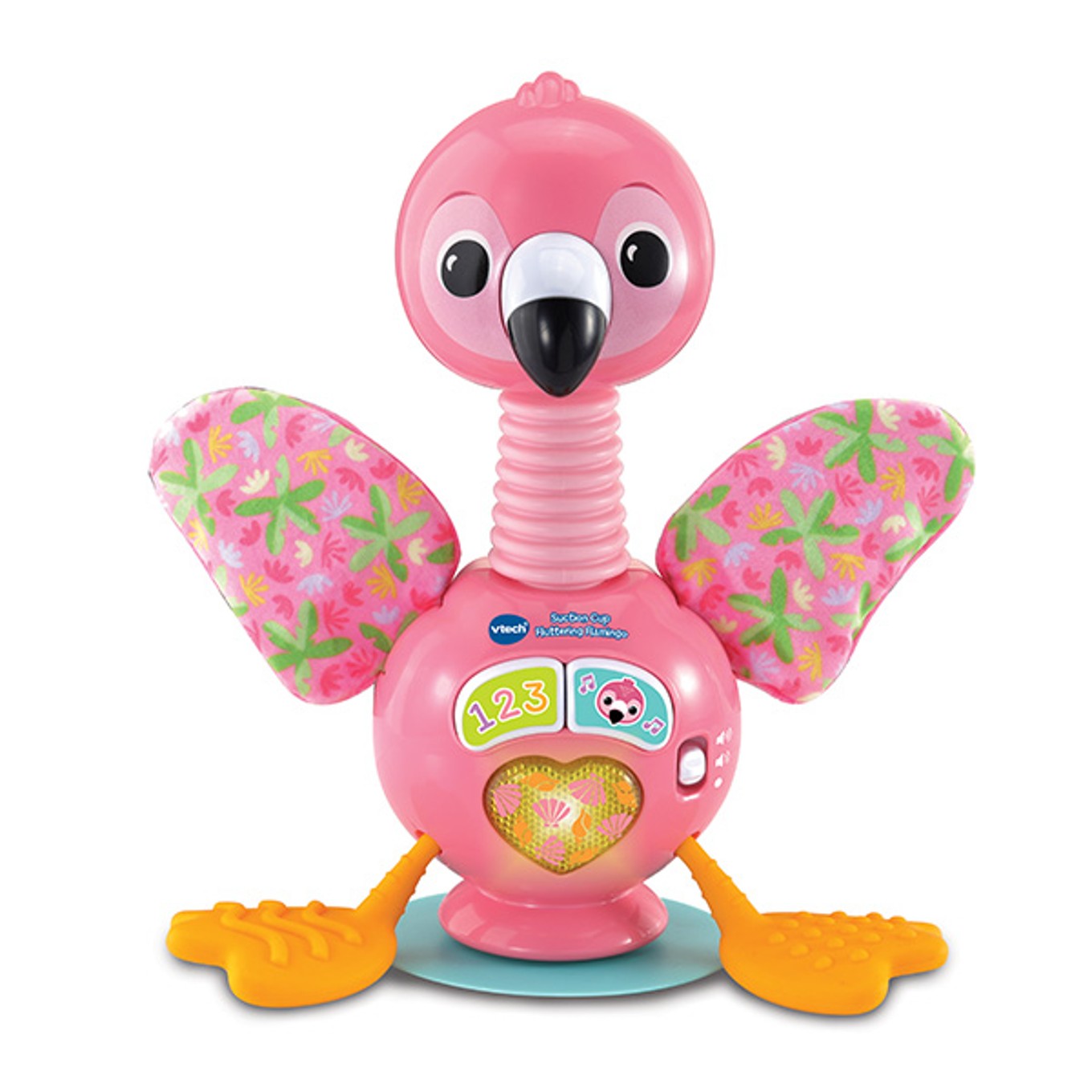
  • Glowing heart light and chunky buttons introduce colours, numbers, and music to stimulate your baby’s senses with sensory-rich play
  • Features varied textures and movements that encourage exploration and hands-on learning.
  • Babies can bend Flamingo’s neck and pull the soft, textured silicone legs for a fun surprise.
  • Strong suction base attaches firmly to highchairs or tables.
  • Supports development by enhancing fine motor skills, coordination during playtime.
Best for ages:
6 to 24 Months
Highlights
Adorable flamingo toy with lights, music, textures, and movement. Encourages sensory exploration, fine motor skills, and playtime fun with a secure highchair suction base.
Description
Brighten playtime with this adorable flamingo highchair buddy! Featuring a glowing heart light and chunky buttons that introduce colours, numbers, and music, it’s perfect for engaging your baby’s senses. The toy includes a variety of textures and movements to encourage exploration and tactile discovery. Its secure suction base keeps it steady on highchairs or tables. Babies will love bending the flamingo’s neck to see its head wobble and pulling the soft, textured silicone legs for a fun surprise. Ideal for developing fine motor skills, coordination, and sensory stimulation while keeping little ones happily entertained at mealtime or playtime.
  • Product Number: 80-587103
  • 2 x AAA (included) Batteries Required