










Home
»
Toddler
»
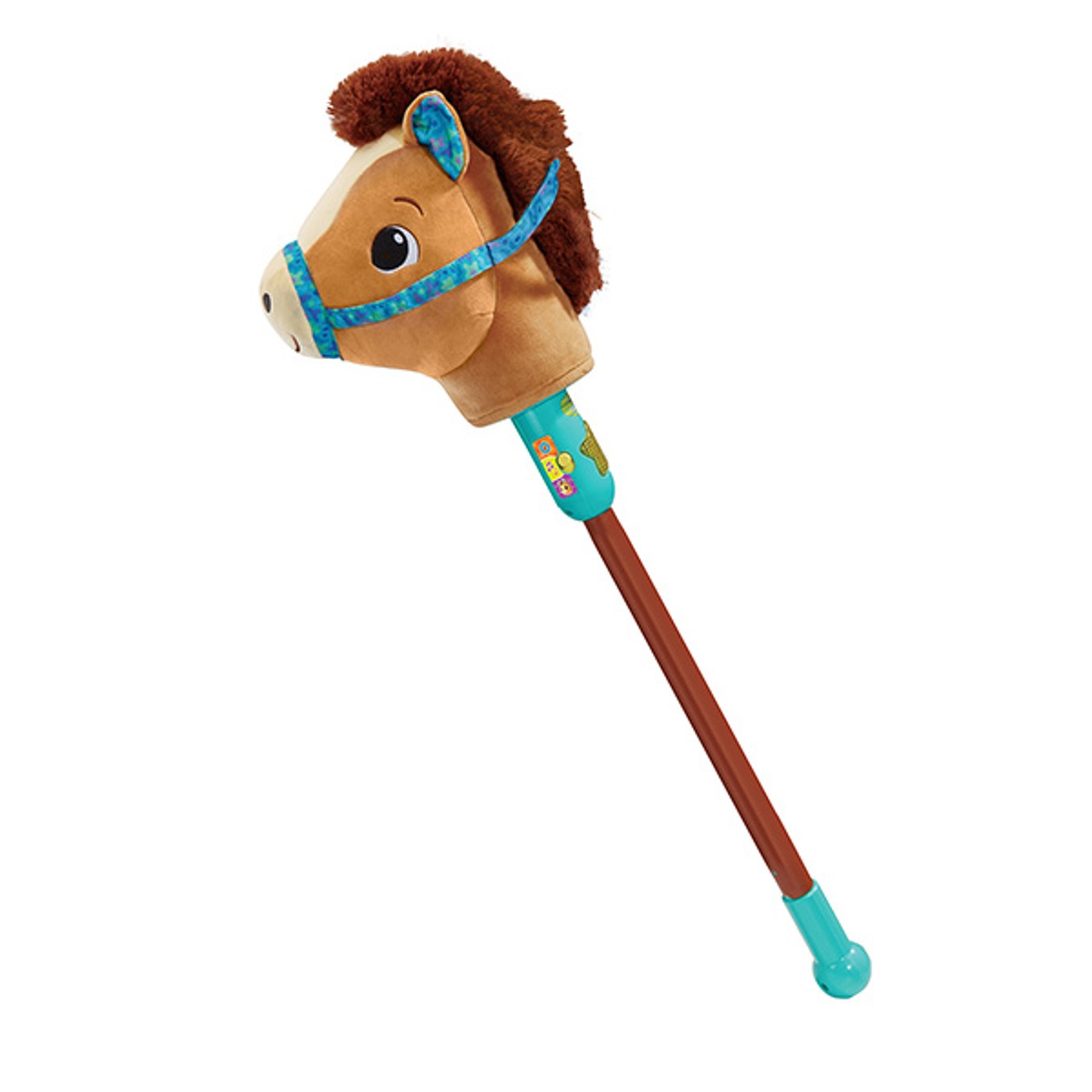
Trotting Tunes Hobby Horse
2-5
YEARS

Trotting Tunes Hobby Horse

£19.99
Temporarily out of stock

This is a carousel. Use Next and Previous buttons to navigate.

Developmental Benefits

Auditory Stimulation
Independent Play
Motor Skills
Role Play

Developmental Benefits

Trotting Tunes Hobby Horse

Auditory Stimulation
  • Fun and interesting sound effects draw baby’s attention to play.
  • Even very early in life babies can hear a wide variety of sounds. Infants will turn towards the sound of a toy and begin to reach towards it. This ability to recognise the direction that a sound is coming from improves greatly during the first few years of life. Young infants listen longer to the sound of human voice and seem to prefer it to any other sound. They are especially aware of the sound of language and like to be spoken to slowly and with a high pitch. This is sometimes referred to as ‘infant directed speech’ or even ‘baby talk’. Young babies are quite sensitive in their auditory abilities and can perceive all the categorical sound distinctions in world languages. As babies develop their auditory abilities narrow so that eventually babies are only sensitive to those sound categories specific to their native language.
    As soon as babies are born they are influenced by what they hear around them and modify what they able to hear, accordingly. At the same time they become increasingly sensitive to music and musical patterns. Even in their first year babies are distinguishing between musical tunes on the basis of rhythmic patterns and later they begin to recognise the same melody played in a different key. Giving babies plenty of opportunities to hear music, singing, rhythm and talk enhances their learning and prepares them for the social world where they will talk, sing, play and listen to music.
Independent Play
  • Games and voice prompts allow children to control the pace.
  • Early play in infants tends to be solitary or takes place alongside other children. Young children learn how to interact with other children through play but they can also explore and learn independently. The initial play experience for infants is when they begin to explore through moving and acting upon the world. Many toys offer infants the opportunity to learn more about their world. Young children will sometimes act out some aspect of their lives e.g. going to the shops and then they involve their toys in these activities. These young children are playing independently but they are also reinforcing their understanding of the social world by acting out scenarios.
    Young children can consolidate their existing skills by repeating actions whilst playing a game. Learning to play independently has its benefits, for instance, children using an educational game can control their own pace. Children sometimes choose to work independently in order to build up their confidence. Toys and computer games that facilitate independent activity at the right level for the child enhance problem solving skills and increase hand and eye coordination. Although cooperative play increases during childhood, children still spend the equivalent amount of time in solitary or independent play.
Motor Skills
  • Encourages fine motor skill development.
  • An infant’s growth and development in the first year of life is rapid. Many movements that young babies make are in preparation for the next stage of their development. When young babies watch a mobile they are constantly moving their head, arms, legs and even their mouths in response to the movement of the toy. Sound and movement attract a baby’s attention; if a toy is placed almost within reach of babies their movements become more animated. Bath toys provide opportunities to develop and use motor skills to great effect. For example, a young baby has greater control over their leg movements than their arms. You will often see young babies in a bath reaching with their legs towards a floating toy and kicking. All these movements strengthen muscles in readiness for the next stage - walking.
    As babies develop they become more adept at grasping objects. Young infants learn to grasp an object, for instance a cube. The grasping, at first, is quite clumsy but through repetition, and across time, infants become adept at grasping and develop fine motor skills. Infants first use the ulnar grasp where their fingers close against the palm when trying to hold an object. Within another month they are able to move the object from hand to hand. After the first year, infants adopt the ‘pincer grasp’ where they use their thumb and index finger to grasp even very tiny objects. Shape sorters help infants to fine tune their visual perception and hand coordination. Soon infants are building towers with two cubes; this also requires fine coordination skills. As the child grows computer games have been shown to help with hand and eye coordination. Spatial skills can also be enhanced when playing games that require concentration, quick responses and finely tuned motor skills.
Role Play
  • Develops imagination and encourages cooperation, listening and turn-taking.
  • Role play is a form of social pretend play. Children benefit from social pretend play because it can help them to revisit events that may have provoked some anxiety in the past. For instance, after a visit to the doctors children often play at being doctors and nurses. Role play not only reflects but also contributes to children’s cognitive and social skills. Playing out an experience enables children to understand more about it.
    Research has shown that during social pretend play, young children’s interactions last longer, are more engaging and also more cooperative. Nursery school children who spend more time in socio-dramatic role playing are also perceived as more socially competent by their teachers. Role play enhances many cognitive abilities such as sustained attention, memory, language and literacy skills, and helps children to understand and manage their emotions. Role play is generally a social activity but some children can engage in solitary role play where they create imaginary companions. Games where children can create worlds and populate them with their own characters can be beneficial.
  • Features music and learning modes with cheerful songs and fun horse facts
  • Motion sensor adjusts music pace based on riding speed—slow trot or fast gallop
  • Light up star button triggers playful phrases, sound effects, and music changes
  • Encourages active, imaginative play and supports movement and early learning
  • Easy two-step assembly for quick and simple setup
Best for ages:
2 to 5 Years
Highlights
Ride the Trotting Tunes Hobby Horse to hear fun sounds, songs, and horse facts. Motion sensor and light up star boost active, imaginative and musical play.
Description
Giddy up for fun with the Trotting Tunes Hobby Horse! Ride along to exciting sounds in music and learning modes, with cheerful songs and fun horse facts. The motion sensor responds to your child’s pace—trot slowly for gentle tunes or gallop fast for lively music that keeps up with the action. Press the light up star for playful phrases, sound effects, and musical changes that add even more excitement. With simple two-step assembly, the horse’s head easily connects to the stick for quick setup. Perfect for imaginative play, this interactive hobby horse encourages movement, learning, and joyful riding adventures every time!
  • Product Number: 80-588403
  • 2 x AA (included) Batteries Required
  • Adult Assembly Required