










Home
»
Favourite Characters
»
Toy Story 5 Buzz Lightyear Learning Watch
3-6
YEARS

Toy Story 5 Buzz Lightyear Learning Watch

£19.99
Temporarily out of stock

This is a carousel. Use Next and Previous buttons to navigate.

Developmental Benefits

Basic Maths Skills
Hand Eye Coordination
Language Development

Developmental Benefits

Toy Story 5 Buzz Lightyear Learning Watch

Basic Maths Skills
  • Develops counting and number identification.
  • Even young babies can discriminate between a small set of objects and a large set of objects. Young children learn to match their culture’s number words and symbols (e.g. 1, 2, and 3) to specific quantities. Research has shown that maths skills can improve with practice; young children who are given plenty of opportunity to work and play with numbers and counting will improve their basic maths skills. Counting rhymes are very popular with babies and young children and teach them basic maths concepts in a fun way. A young child may make mistakes when learning to count (e.g. missing out the number 6 when counting 10 bricks). But this young child is still demonstrating the basic maths ability; linking number words to actual numbers, realising that each item can only have one number word, and that the numbers have a sequence. Number games, learning about sequences and singing counting rhymes all help to enhance children’s basic maths skills.
    Repetition is also important, for instance, singing counting rhymes over and over again gets babies used to number words and their sequence. Toys that count as babies, for instance, place bricks in a slot and computer games that present children with fun maths problems are also useful learning tools. Play and practice with numbers is fun for babies and is essential for the development of young children’s understanding of quantity.
Hand Eye Coordination
  • Aiming and concentrating on a target improves hand/eye coordination.
  • Humans have highly developed manual dexterity skills that distinguish them from any other species on this planet. This manual dexterity emerges during the infant’s first year and, with plenty of opportunities to manipulate and play with toys and objects, becomes a highly tuned ability. Babies will reach and grasp for objects in an uncoordinated manner from an early age. As they begin to gain control over their movements infants succeed in reaching for and grasping toys. The first attempts by babies to grasp toys in their hands involve using the palm of their hand with all their fingers around the object. As development occurs through physical maturation and plenty of opportunities to play with toys, grasping becomes more sophisticated. The use of the opposable thumb and index finger allows infants to pick up very small objects in what is termed a ‘pincer grasp’. This finely tuned motor skill emerges at the end of first year of life.
    The development of hand and eye coordination skills continues throughout childhood where opportunities to play games that require children to manoeuvre objects, build tall towers or hit targets on a computer screen facilitate the development of finely-tuned hand and eye coordination.
Language Development
  • Introduces the alphabet, letter sounds and vocabulary.
  • Babies start to babble at an early age and this can be seen as the first signs of language. They are predisposed to pick up the sounds of the language that they hear around them. Adults can facilitate babies’ language development by playing with them, focussing on particular toys, reading books and naming everyday objects. The more babies are exposed to language the faster they will begin to pick up it up. There are social skills involved in language acquisition such as realising that it is necessary to wait until the other person has finished speaking. Babies begin to learn about conversational turn-taking from an early age; if a baby is babbling the adult waits for a pause and then talks to the baby. Babies learn to take turns even before they are using words. Social interaction is important for language development and turn-taking games are a fun and educational way for babies and young children to learn.
    Young children also need to practice their language skills. Toys that name alphabet letters and everyday words satisfy young children’s need for repetition and rehearsal when practicing words and sounds. For instance, young children can press a button repetitively to hear the same sound or word again. Babies and children learn a lot through repetition and pick up words rapidly in this way. Once children begin to read their vocabulary expands enormously.
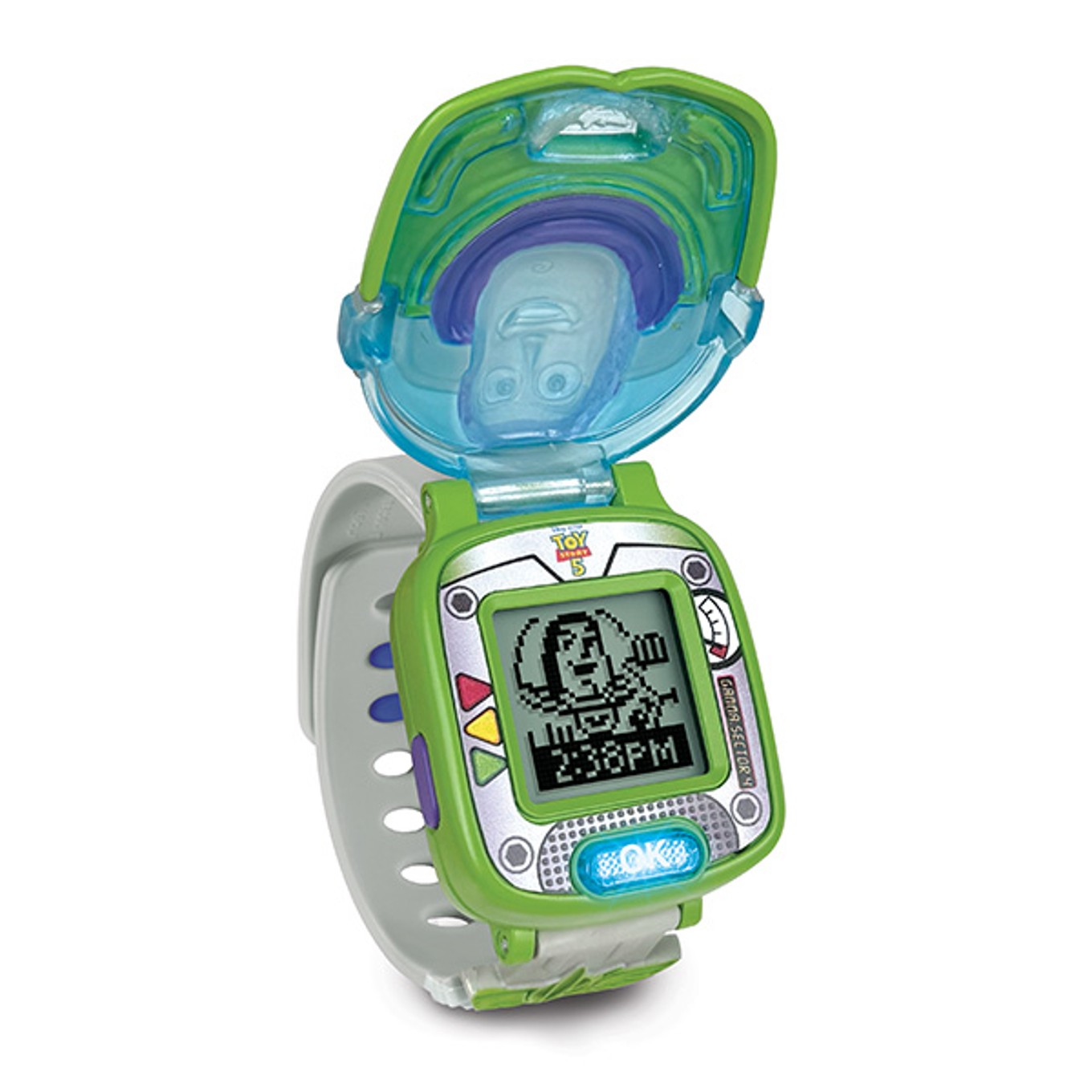
  • Take learning to infinity and beyond with the Buzz Lightyear Learning Watch by VTech!
  • Build time-telling confidence with a stopwatch, timer and alarm.
  • Customise with 9 cool clock faces featuring your favourite Toy Story 5 characters.
  • Learn basic maths skills, Spanish numbers, patterns and more with 4 fun learning games voiced by Buzz himself!
  • Perfectly sized for little hands, this gadget provides on-the-go learning fun - with style!
Best for ages:
3 to 6 Years
Highlights
Take learning to infinity and beyond with the Buzz Lightyear Learning Watch by VTech! Play 4 fun learning games with Buzz and the toys. Boost time-telling confidence with the clock, alarm, stopwatch & timer.
Description
Take learning to infinity and beyond with the Buzz Lightyear Learning Watch by VTech! Flip open the 3D Buzz cover to access 9 cool clock faces featuring your favourite Toy Story characters. Build time-telling confidence with a stopwatch, timer and alarm. Learn basic maths skills, Spanish numbers, patterns and more with 4 fun learning games voiced by Buzz himself! Spot the hidden Hi-tech Edition Buzzes, recognise the toys from puzzling pictures, and search for Stars using a crane. Perfectly sized for little hands, this gadget provides on-the-go learning fun - with style!
  • Product Number: 80-591903
  • 1 x CR2450 lithium coin battery (included) Batteries Required
  • Warning! Not suitable for children under 36 months. Small parts. Choking hazard.