











Home
»
KidiCreative
»
Kidi® Guitar Superstar
5+
YEARS

Kidi® Guitar Superstar

£49.99
Temporarily out of stock

This is a carousel. Use Next and Previous buttons to navigate.

Developmental Benefits

Creative Play
Hand Eye Coordination
Independent Play
Musical Creativity
Role Play

Developmental Benefits

Kidi® Guitar Superstar

Creative Play
  • Use imagination in a variety of ways and contexts to communicate ideas
  • When children engage in creative play they are showing that they have the ability to produce something new and original. Children benefit from opportunities where they are free to use their imagination and explore. In order for creative play to occur children need to be in an environment that is rich in stimulation. Curiousity will drive children to take part in creative play.
    Creative play is different from other forms of play; it enables children to develop confidence in their own abilities as they begin to think and work independently. Games and activities that provide choices and also a number of alternative solutions encourage a certain amount of risk-taking. Games with alternative answers can lead children to think creatively and differently. Children need encouragement to play and think creatively. Opportunities to engage in creative play boost children’s confidence and enable them to come up with better ideas. Children benefit from the knowledge they gain through creative play.
Hand Eye Coordination
  • Aiming and concentrating on a target improves hand/eye coordination.
  • Humans have highly developed manual dexterity skills that distinguish them from any other species on this planet. This manual dexterity emerges during the infant’s first year and, with plenty of opportunities to manipulate and play with toys and objects, becomes a highly tuned ability. Babies will reach and grasp for objects in an uncoordinated manner from an early age. As they begin to gain control over their movements infants succeed in reaching for and grasping toys. The first attempts by babies to grasp toys in their hands involve using the palm of their hand with all their fingers around the object. As development occurs through physical maturation and plenty of opportunities to play with toys, grasping becomes more sophisticated. The use of the opposable thumb and index finger allows infants to pick up very small objects in what is termed a ‘pincer grasp’. This finely tuned motor skill emerges at the end of first year of life.
    The development of hand and eye coordination skills continues throughout childhood where opportunities to play games that require children to manoeuvre objects, build tall towers or hit targets on a computer screen facilitate the development of finely-tuned hand and eye coordination.
Independent Play
  • Games and voice prompts allow children to control the pace.
  • Early play in infants tends to be solitary or takes place alongside other children. Young children learn how to interact with other children through play but they can also explore and learn independently. The initial play experience for infants is when they begin to explore through moving and acting upon the world. Many toys offer infants the opportunity to learn more about their world. Young children will sometimes act out some aspect of their lives e.g. going to the shops and then they involve their toys in these activities. These young children are playing independently but they are also reinforcing their understanding of the social world by acting out scenarios.
    Young children can consolidate their existing skills by repeating actions whilst playing a game. Learning to play independently has its benefits, for instance, children using an educational game can control their own pace. Children sometimes choose to work independently in order to build up their confidence. Toys and computer games that facilitate independent activity at the right level for the child enhance problem solving skills and increase hand and eye coordination. Although cooperative play increases during childhood, children still spend the equivalent amount of time in solitary or independent play.
Musical Creativity
  • Enhances musical skills with music and sound activities.
  • Babies are sensitive to sound patterns early in life and respond emotionally to voices. Even before they are born infants detect and monitor sound to a certain extent. During the second half of their first year babies are particularly sensitive to differences in beat and rhythm. Music is a complex form of auditory stimulation that is linked to human movement. Infants are drawn to music and are very good at being able to discern different musical structures. In a recent survey we found that parents often choose a particular traditional nursery, for example twinkle, twinkle little star, because of the gestures linked to the song. Babies love music and nursery rhymes that have plenty of repetition and gestures.
    Children also love to experiment with music. Toys that allow children to create their own tunes facilitate learning. Children can learn about a wide variety of sounds and tempo. They can also learn about the sounds of different musical instruments through pressing keys on a musical toy. Children who grow up in the Western world tend to be exposed to the typical even-beat pattern of Western music. There is a link between learning, singing and rhythm that is related to the type of culture that children grow up in. Musical creativity can be nurtured through the infant’s and child’s exposure to music, musical toys and instruments.
Role Play
  • Develops imagination and encourages cooperation, listening and turn-taking.
  • Role play is a form of social pretend play. Children benefit from social pretend play because it can help them to revisit events that may have provoked some anxiety in the past. For instance, after a visit to the doctors children often play at being doctors and nurses. Role play not only reflects but also contributes to children’s cognitive and social skills. Playing out an experience enables children to understand more about it.
    Research has shown that during social pretend play, young children’s interactions last longer, are more engaging and also more cooperative. Nursery school children who spend more time in socio-dramatic role playing are also perceived as more socially competent by their teachers. Role play enhances many cognitive abilities such as sustained attention, memory, language and literacy skills, and helps children to understand and manage their emotions. Role play is generally a social activity but some children can engage in solitary role play where they create imaginary companions. Games where children can create worlds and populate them with their own characters can be beneficial.
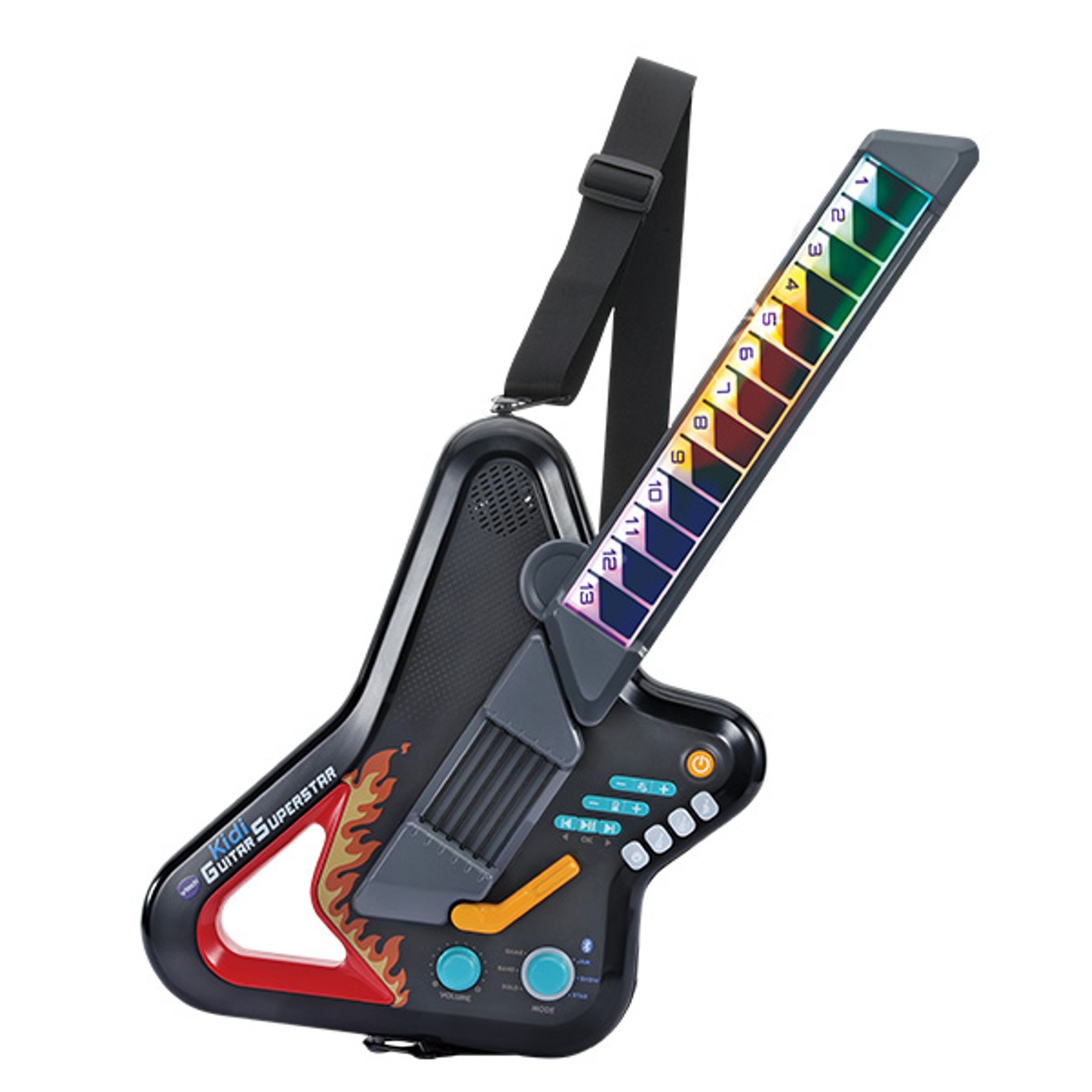
  • 12-in-1 interactive guitar for kids with touch-sensitive strings and multicoloured light up fret buttons!
  • 6 ways to play, including Solo Mode, Band Mode, and the fun Catch-the-Light rhythm game!
  • 4 guitar sound styles plus 30+ built-in melodies spanning rock, pop, country, and jazz.
  • Bluetooth streaming modes to play along with your favourite songs!
  • Features motion sensor, headphone jack, guitar strap, and foldable design for easy storage.
Best for ages:
5+ Years
Highlights
Rock out with Kidi Guitar Superstar! This 12-in-1 guitar for kids features light up frets, touch-sensitive strings, Bluetooth play-along, built-in songs, and creative band modes for superstar fun!
Description
Unleash your inner rockstar with the Kidi Guitar Superstar by VTech, the ultimate 12-in-1 guitar for kids! Featuring interactive touch-sensitive strings, multicoloured light up fret buttons, and four awesome guitar styles, kids can explore clean electric, distortion, acoustic and funny sounds. Play solo, build a band, or stream your favourite songs via Bluetooth to jam along to. With 30+ built-in melodies, the fun Catch-the-Light rhythm game, motion sensor, and recording features, creativity takes centre stage! The foldable design, guitar strap, and headphone jack make it perfect for performances anywhere. The stage is yours – let’s rock!
  • Product Number: 80-591003
  • 4 x AA (included) Batteries Required
  • Warning! Not suitable for children under 36 months. Small parts. Choking hazard.